The Art of AI-ing Better: Human Wisdom as AI Compass
AI amplifies whatever process it's bolted onto, broken or not. How 25 years of domain pattern recognition guides AI to compress six-month cycles into hours.
A Reality-Based Guide to Human-AI Collaboration from 25 Years in the Corporate Trenches
The Cognitive Migration Trap
Last week, I watched a 40-person team spend three hours in a “brainstorming session” about how AI could “revolutionize” their quarterly reporting process. The irony was palpable: they were using the most inefficient possible method (a massive meeting) to figure out how to become more efficient with AI.
This scene, replayed in conference rooms across every industry, reveals a fundamental misunderstanding about AI implementation. We’re treating AI like a magic solution to spray on our existing problems, rather than a powerful tool that amplifies whatever systems we already have in place.
The result? AI implementations that create more sophisticated versions of the same organizational dysfunction we started with.
After 25 years navigating global corporate transformations across 50+ countries, and spending the last two years systematically integrating AI into real business processes, I’ve learned something critical: Most organizations aren’t ready for AI not because they lack technical capability, but because they haven’t mastered the fundamentals of getting work done effectively.
The Paper Tiger Meets AI: When Technology Amplifies Dysfunction
Remember the “paper tiger” cultures I’ve written about—organizations that excel at creating the appearance of progress while avoiding actual results? AI is becoming their latest performance prop.
I recently encountered a company that spent six months building an AI system to “automate insights generation” from their data. The system worked beautifully from a technical standpoint. The problem? The underlying data was so poorly managed, inconsistently defined, and rarely acted upon that the AI was essentially generating automated nonsense at scale.
The classic AI implementation trap looks like this:
- Broken Process Identification: “Our quarterly reviews take too long”
- AI Solution: “Let’s use AI to automate report generation”
- Technical Success: The AI produces reports faster
- Business Failure: The reports are still meaningless because the underlying process was flawed
- Organizational Response: “We need better AI”
The reality? They needed better processes before they needed better AI.

The Reality-First AI Framework: A Different Approach
Through hundreds of hours working with AI tools like ChatGPT, Claude, and domain-specific models, I’ve developed what I call the Reality-First AI Framework. This approach starts with organizational health, then strategically applies AI to amplify what’s already working.
Phase 1: Reality Audit Before AI Audit
Before implementing any AI solution, ask these fundamental questions:
Process Health Check:
- Do we regularly complete projects as originally scoped?
- Can we measure the actual impact of our current initiatives?
- Do our meetings typically result in clear decisions and actions?
- Is our data trustworthy enough that humans make good decisions with it?
Communication Health Check:
- Do we have a shared understanding of what “success” means?
- Can we distinguish between activity and progress?
- Do we celebrate completions more than launches?
If you’re failing these basic organizational competencies, AI will only automate and amplify your dysfunction.
Phase 2: Human Wisdom as AI Compass
The most successful AI implementations I’ve seen don’t start with the technology—they start with deep human expertise about what actually needs to be done.
Case Study: Data Modeling Transformation
In 2016, creating enterprise data models across global aviation infrastructure was a six-month process involving dozens of stakeholder interviews, endless revision cycles, and documentation that often became obsolete before implementation.
When I recently used AI to tackle the same challenge, I didn’t just prompt the AI with “create a data model.” I brought 25 years of pattern recognition about:
- Which data relationships actually matter in practice
- How different stakeholder groups think about information
- What level of detail enables action vs. creates paralysis
- Which modeling approaches survive contact with operational reality
The prompting sequence looked like this:
Human Context: “I need a conceptual data model for inventory spare parts
that will actually be used by maintenance teams, procurement, and finance.
Based on 20+ years of implementation experience, the critical
relationships are…“
AI Generation: [Detailed model incorporating business context]
Human Refinement: “This captures the technical relationships well,
but in practice, finance always needs to track cost center allocation
differently than procurement expects…“
AI Iteration: [Refined model addressing practical constraints]
Result: What traditionally took months was completed in hours, but with higher quality because human expertise guided every iteration.
Phase 3: “Enough” Thinking for AI Projects
One of the biggest AI implementation failures I see is the “more is better” trap—organizations that chase every possible AI capability rather than focusing on specific, measurable improvements.
Apply the “Enough” Framework:
Technical Enough: What’s the minimum AI capability that solves the core problem? Complexity Enough: How sophisticated can the solution be while remaining maintainable? Scope Enough: What boundaries keep this project focused and finishable? Integration Enough: How much system integration is needed for real value?
Example: Rather than building a comprehensive “AI-powered business intelligence platform,” start with “AI-assisted monthly reporting that reduces preparation time by 50% and increases data accuracy.”
The Three Levels of AI-ing Better
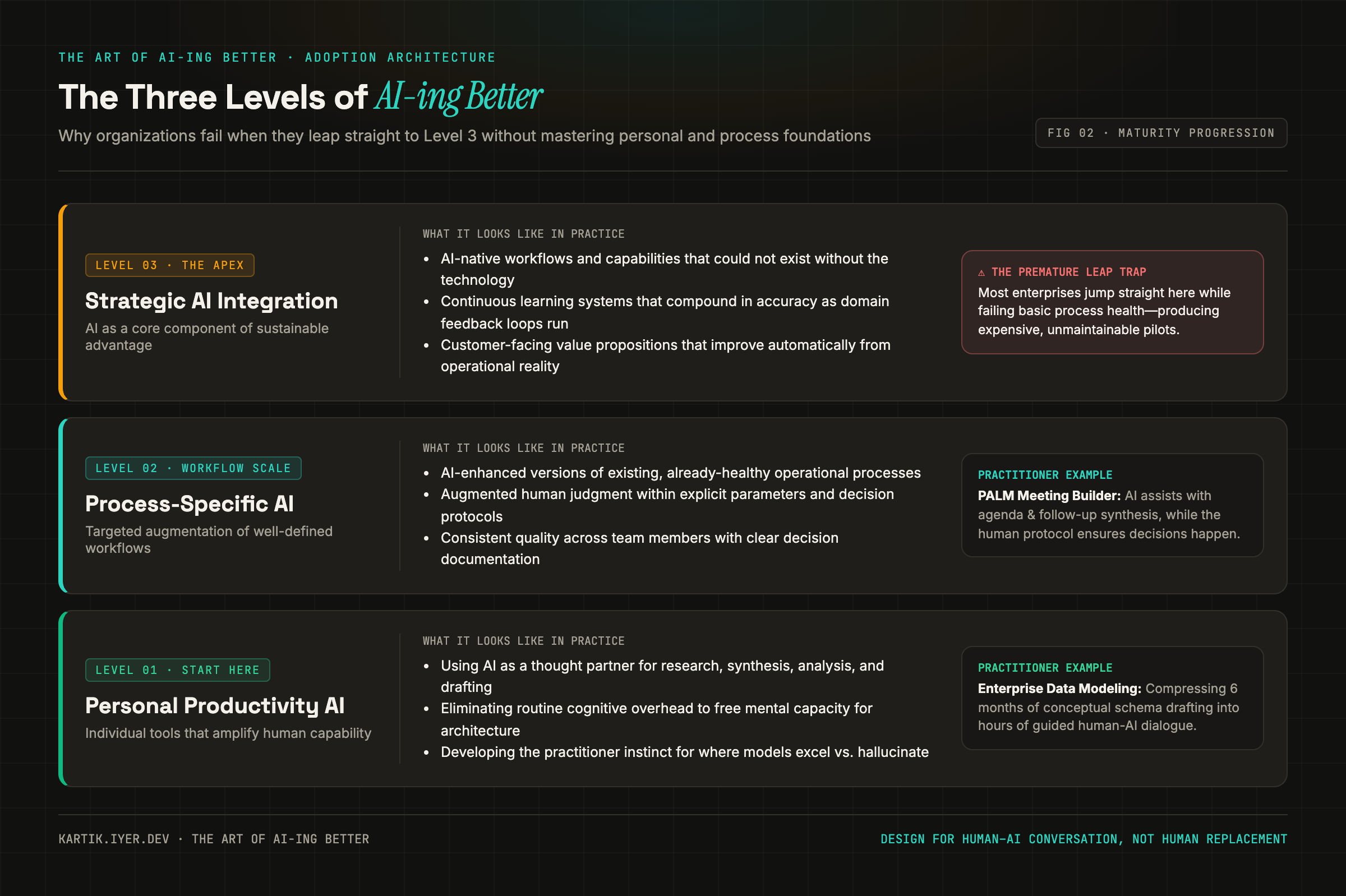
Based on my experience implementing AI across different organizational contexts, successful adoption happens in three distinct levels:
Level 1: Personal Productivity AI
Individual tools that amplify human capability
What it looks like:
- Using AI for writing, analysis, and research acceleration
- Personal workflow optimization and decision support
- Individual skill augmentation and learning acceleration
Success indicators:
- Measurable time savings on routine cognitive tasks
- Higher quality outputs with the same effort investment
- Increased capacity for strategic thinking
My example: The data modeling work that went from months to hours wasn’t just about speed—it was about freeing mental capacity for higher-level architectural thinking.
Level 2: Process-Specific AI
Targeted automation of well-defined workflows
What it looks like:
- AI-enhanced versions of existing successful processes
- Automation of routine decision-making within clear parameters
- Augmented human judgment for complex but structured tasks
Success indicators:
- Reduced cycle time for standard processes
- More consistent quality across different team members
- Better decision documentation and learning capture
Real-world example: I built tools like the PALM Meeting Framework that use structured approaches to transform meeting effectiveness. The AI component helps generate agendas and follow-ups, but the human framework ensures the meetings actually accomplish something.
Level 3: Strategic AI Integration
AI as a core component of competitive advantage
What it looks like:
- AI-native business processes that couldn’t exist without the technology
- Continuous learning systems that improve over time
- AI-enabled services or products that create new value propositions
Success indicators:
- New capabilities that weren’t possible before AI
- Sustainable competitive advantages based on data and learning
- Customer value propositions that improve automatically
Most organizations aren’t ready for Level 3 until they’ve mastered Levels 1 and 2. Yet many jump straight to strategic AI integration and wonder why it doesn’t work.
Practical AI-Better Principles from the Trenches
After implementing AI across dozens of different use cases, here are the principles that consistently separate success from failure:
1. Start with Human Excellence, Add AI Acceleration
Wrong approach: “Our process is slow and error-prone. Let’s use AI to fix it.” Right approach: “Our process works well when done correctly. Let’s use AI to make the correct version faster and more consistent.”
AI amplifies whatever you give it. If you give it broken processes, you get broken results faster.
2. Use AI to Eliminate Overhead, Not Replace Judgment
Wrong approach: “Let AI make the decisions so humans don’t have to.” Right approach: “Let AI handle the routine analysis so humans can focus on judgment and strategy.”
The most successful AI implementations I’ve built handle the time-consuming, routine cognitive work that prevents humans from exercising high-level judgment.
3. Design for Human-AI Conversation, Not Human-AI Replacement
Wrong approach: “Build an AI system that works without human intervention.” Right approach: “Build an AI system that makes human expertise more effective and scalable.”
My data modeling breakthrough came from treating AI as a sophisticated thought partner, not a replacement for architectural thinking.
4. Measure Outcome Changes, Not Technology Adoption
Wrong approach: “We deployed AI successfully because X% of users are using the tool.” Right approach: “We deployed AI successfully because we can measure specific improvements in [time/quality/accuracy/cost].”
Every AI implementation should have a clear, measurable hypothesis about what will improve and by how much.
5. Build Learning Systems, Not Static Solutions
Wrong approach: “We built an AI solution that handles our current process perfectly.” Right approach: “We built an AI solution that gets better as our understanding of the problem evolves.”
The best AI implementations create feedback loops that improve both the technology and human understanding over time.
Red Flags: Signs You’re AI-ing Wrong
Based on patterns I’ve observed across multiple organizations, here are the warning signs of dysfunctional AI implementation:
Organizational Red Flags
- AI projects led by IT without deep business process involvement
- Multiple AI initiatives without clear success metrics
- AI solutions being built for processes that don’t work well manually
- “AI strategy” documents longer than 10 pages
- AI implementation timelines longer than 6 months for initial value
Technical Red Flags
- Building custom AI models before exploring existing tool integration
- AI systems that require perfect data to function
- AI solutions that can’t be easily explained to end users
- AI implementations that eliminate all human decision points
- AI tools that require extensive training to use effectively
Cultural Red Flags
- Treating AI adoption as a compliance requirement rather than capability building
- Resistance to measuring specific improvements from AI implementation
- AI projects that don’t involve the people who do the actual work
- Fear-based messaging about AI implementation rather than opportunity-focused
- AI initiatives that don’t connect to clear business value
The Reality-Based AI Toolkit
To support others in implementing reality-first AI approaches, I’ve built several practical tools that embody these principles:
Data Maturity Assessment Dashboard: Helps organizations understand their foundational data capabilities before implementing AI solutions.
Strategic Data & AI Readiness Charter (Chartr): Guides teams through defining focused AI initiatives that connect to real business outcomes.
PALM Meeting Framework: Demonstrates how structured human processes can be enhanced (not replaced) by AI assistance.
Each tool focuses on human judgment enhanced by AI capability, rather than AI systems that eliminate human involvement.
The Future Belongs to Human-AI Hybrid Excellence
The VentureBeat article about knowledge workers facing an existential crisis gets part of the story right: the nature of knowledge work is changing fundamentally. But the solution isn’t for humans to compete with AI or to be replaced by it.
The solution is to become excellent at human-AI collaboration—to develop the skills and systems that make AI a powerful amplifier of human capability rather than a replacement for it.
This requires a different mindset than either AI fear or AI hype. It requires:
- Honest assessment of what humans do better than AI
- Strategic implementation that starts with process health
- Continuous learning about effective human-AI interaction patterns
- Outcome focus that measures real improvements, not just technology adoption
Your Next Steps: Beginning the Reality-Based AI Journey
If you’re ready to move beyond AI theater and toward AI effectiveness, start here:
Week 1: Reality Audit
- Identify one process that currently works well when done correctly
- Document the specific outcomes this process should achieve
- Measure how much time is spent on routine vs. strategic aspects
Week 2: AI Exploration
- Find one AI tool that could handle routine aspects of your chosen process
- Spend 5 hours experimenting with how AI could accelerate (not replace) the work
- Focus on preserving human judgment while eliminating routine overhead
Week 3: Pilot Implementation
- Run the AI-enhanced process for a limited scope
- Measure specific improvements in time, quality, or consistency
- Document what works and what needs refinement
Week 4: Scale Decision
- Based on measurable results, decide whether to expand, modify, or abandon
- If expanding, identify the next process that could benefit from similar enhancement
- If abandoning, document lessons learned for future AI exploration
The Art of AI-ing Better: A Personal Invitation
Twenty-five years ago, I started my career in environments where success meant managing complexity through careful process design and human collaboration. Today, I’m implementing AI solutions that would have been science fiction then.
The continuity isn’t the technology—it’s the focus on what actually works in practice, with real people, under real constraints, to achieve real outcomes.
AI-ing better isn’t about having the latest technology or the most sophisticated models. It’s about applying decades of hard-won wisdom about how to get things done effectively, then using AI to make that effectiveness scalable.
If you’re tired of AI hype and ready for AI reality, if you believe technology should amplify human capability rather than replace it, if you want to build solutions that work in practice rather than just in theory—then you’re already on the path to AI-ing better.
The cognitive migration the VentureBeat article describes isn’t about humans becoming obsolete. It’s about humans becoming more effective by partnering strategically with AI.
That migration begins with the recognition that the most powerful AI implementations start with the oldest technology of all: clear thinking about what actually needs to be done.
What patterns have you observed in AI implementations? Where have you seen the biggest gaps between AI promise and AI reality? Share your experiences in the comments—the path to AI-ing better is one we’ll navigate together.
The Dutch Reckoning: AI Automation and the Sovereign Fiscal Architecture of the Netherlands
One-third of Dutch government revenue (€142B/yr) flows directly from employment contributions. What happens when 3.33 million white-collar roles enter the AI automation zone?
The 3-Layer Architecture: Directives, AI Orchestration, and Deterministic Execution
LLMs are probabilistic in an enterprise world that demands determinism. How separating Directives, Orchestration, and Execution makes AI reliable.
The Reality-Based Architecture Manifesto: Authentic Intelligence Over Organizational Theater
Why 25 years of corporate systems optimized for the appearance of progress are now colliding with AI — and how to re-architect the building itself.
The Big Churn: RTO Mandates, Performative Presenteeism, and the Age of Stealth Downsizing
Why blanket return-to-office mandates function as quiet layoffs, and what that costs the workforce that stays.