The 3-Layer Architecture: Directives, AI Orchestration, and Deterministic Execution
LLMs are probabilistic in an enterprise world that demands determinism. How separating Directives, Orchestration, and Execution makes AI reliable.
Why enterprise AI and data governance fail at the execution layer — and how a 3-layer Directive–Orchestration–Execution architecture makes definitions and agentic workflows deterministic, verifiable, and self-annealing.
The Problem with Probabilistic Intelligence
Large language models are extraordinary instruments. They can draft, analyze, synthesize, and reason across vast domains. But they have a fundamental structural characteristic that mirrors the same dysfunction I spent 25 years fighting in large enterprises:
They are probabilistic in a world that demands determinism.
When a board asks “What is our net revenue retention?”, the answer must be exact — not “based on the most likely interpretation.” When a regulator asks “Does your high-risk AI system comply with Article 10?”, the answer must be verifiable — not inferred.
LLMs cannot provide determinism on their own. But they can be orchestrated to invoke systems that can.
This is the core principle behind the 3-Layer Architecture I use every day to build software, model enterprise data, and enforce governance: separating what should be decided from how it is routed from what actually executes.

The Three Layers
Layer 1: Directive (What to Do)
- Nature: Deterministic · Human-authored · Version-controlled
Directives are Standard Operating Procedures and domain invariants written in structured Markdown and JSON Schema. They define the goals, inputs, boundaries, tools to invoke, and edge cases.
Here is the critical practitioner insight: if you cannot write a directive precise enough for a machine to follow, your process isn’t well-defined enough for a human organization to follow consistently either. Writing directives forces operational clarity.
Layer 2: Orchestration (Intelligent Routing)
- Nature: Probabilistic · AI-powered · Adaptive
This is where the LLM agent lives. Its job is intelligent routing — reading the directive, calling deterministic execution tools in the right sequence, handling errors, and surfacing edge cases.
The orchestrator doesn’t try to guess deterministic math or compliance rules itself; it delegates to tested scripts. And crucially, its boundaries are constrained by the deterministic directive layer above it and the deterministic execution layer below it.
Layer 3: Execution (Deterministic Verification)
- Nature: Deterministic · Tested Python/TypeScript · Repeatable
Execution scripts and runtime interceptors handle the actual state changes, schema validations, data transformations, and compliance checks. They are written, tested, and version-controlled so they execute identically every single time.
Why Three Layers? Because Accuracy Compounds
If an LLM is 90% accurate per step, a five-step chained workflow yields $0.90^5 = 59%$ overall accuracy. In enterprise operations or regulated systems, 59% is a coin flip.
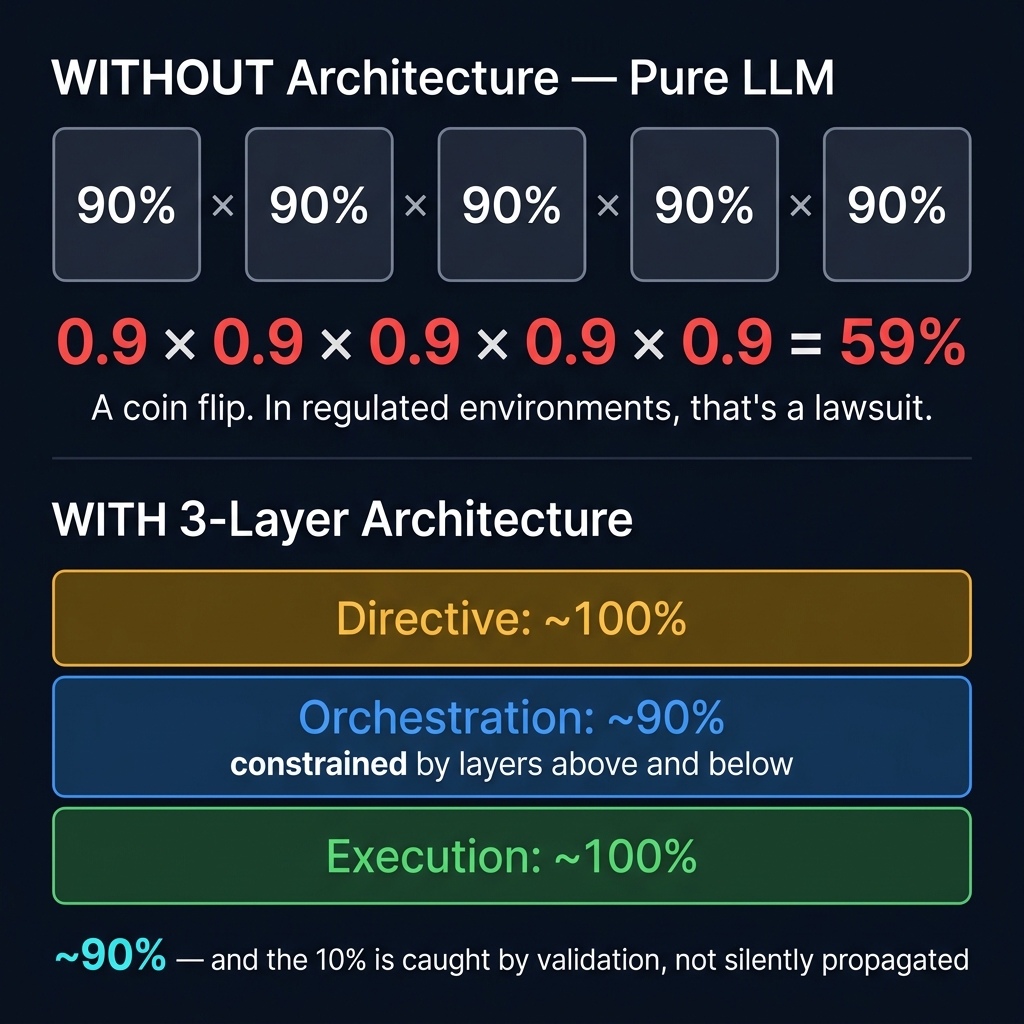
By pushing deterministic logic into tested execution scripts and keeping the LLM focused on orchestration within validated boundaries, system reliability jumps dramatically — and any edge case that fails validation halts cleanly rather than propagating silent corruption downstream.
The Self-Annealing Loop
Most organizational processes decay over time. A well-engineered 3-layer human-AI system gets stronger every time something breaks:
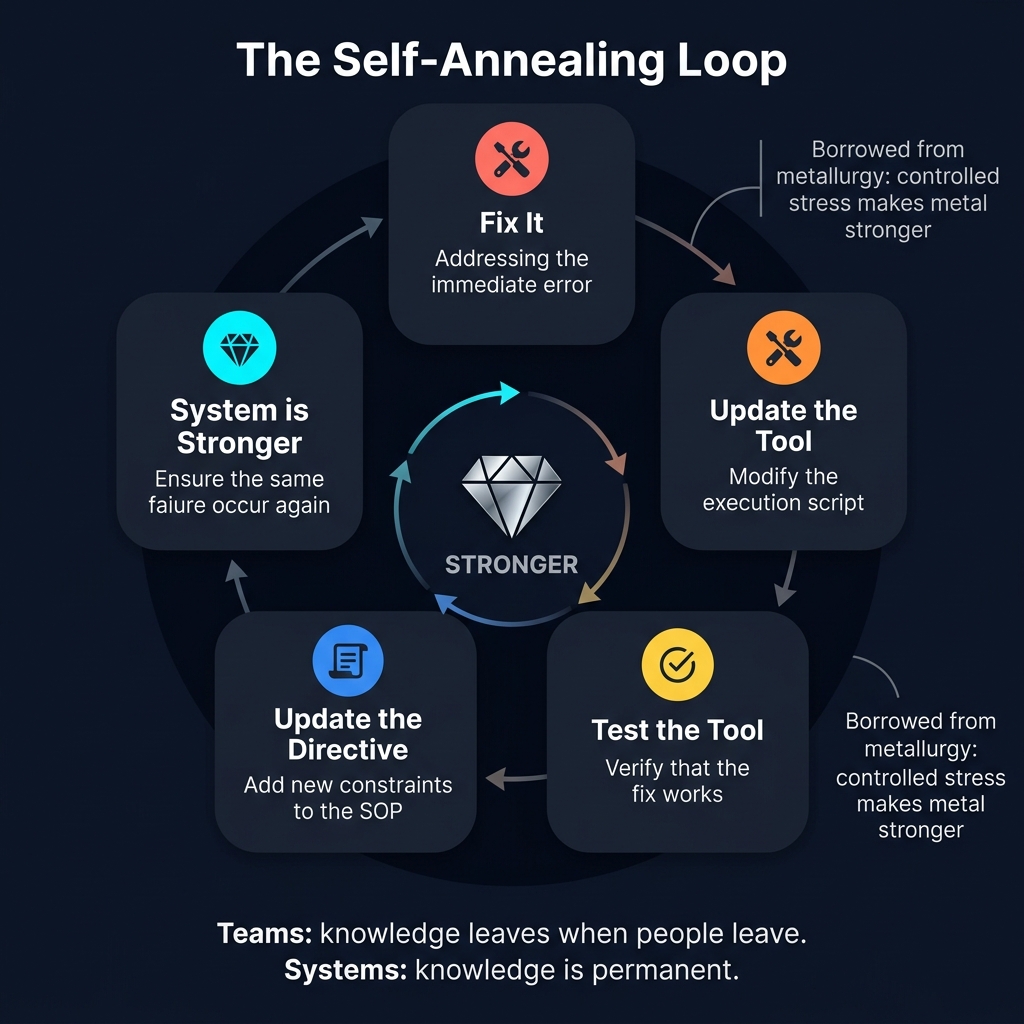
- Catch the failure at the deterministic execution boundary.
- Update and test the execution script to handle the new edge case.
- Update the directive with the newly discovered constraint.
- The system is permanently hardened — the same failure mode cannot recur.
The Prerequisite Nobody Mentions: Domain Wisdom
There is a dangerous misreading of agentic AI that assumes tools can substitute for domain understanding. They cannot.

The 3-layer system is a force multiplier. It multiplies whatever judgment you bring to it. When you feed 25 years of enterprise architecture, master data patterns, and operational reality into the directive layer, AI orchestration produces extraordinary speed and precision. If you feed it vague, unowned definitions, it simply generates confident noise at scale.
The Dutch Reckoning: AI Automation and the Sovereign Fiscal Architecture of the Netherlands
One-third of Dutch government revenue (€142B/yr) flows directly from employment contributions. What happens when 3.33 million white-collar roles enter the AI automation zone?
The Reality-Based Architecture Manifesto: Authentic Intelligence Over Organizational Theater
Why 25 years of corporate systems optimized for the appearance of progress are now colliding with AI — and how to re-architect the building itself.
The Big Churn: RTO Mandates, Performative Presenteeism, and the Age of Stealth Downsizing
Why blanket return-to-office mandates function as quiet layoffs, and what that costs the workforce that stays.
The Art of AI-ing Better: Human Wisdom as AI Compass
AI amplifies whatever process it's bolted onto, broken or not. How 25 years of domain pattern recognition guides AI to compress six-month cycles into hours.