The Reality-Based Architecture Manifesto: Authentic Intelligence Over Organizational Theater
Why 25 years of corporate systems optimized for the appearance of progress are now colliding with AI — and how to re-architect the building itself.
This is not another corporate methodology. This is not a framework with a certification program. This is not a movement seeking followers.
This is an architectural diagnosis of what anyone who has worked inside global enterprises has experienced but rarely names: the structural disconnect between organizational theater and operational reality.
And in the age of Artificial Intelligence, that disconnect has reached a breaking point.
The Problem: Systems Optimized for Illusion
After twenty-five years solving complex operational and architectural problems across global aviation, maritime port operations, telecommunications, and shared services, I have witnessed a pattern so consistent across continents that it cannot be coincidence:
Our organizational systems have evolved to reward the appearance of progress over progress itself.

This isn’t cynicism — it is field observation:
- We celebrate launching initiatives more than completing and sustaining them
- We reward those who manage executive perception more than those who engineer durable systems
- We produce elaborate slide decks and governance charters that never touch physical pipelines
- We hold alignment meetings about alignment meetings to diffuse individual accountability
- We optimize proxy activity metrics while frontline operational reality quietly degrades
- We buy new software platforms to avoid fixing broken business definitions
These are not failures of individual character. They are rational, predictable responses to incentive and governance architectures designed to maintain comfortable illusions rather than confront uncomfortable operational truths.
The AI Inflection Point: Faster Theater vs. Authentic Intelligence
For twenty years, organizations could survive their own theater because human bureaucracy had a natural speed limit. A bad KPI definition, an unowned system boundary, or a performative steering committee could only produce dysfunction as fast as humans could type slides and spreadsheets.
Then Generative and Agentic AI arrived — and removed the speed limit.
Today, most enterprises are force-fitting frontier AI onto processes built for proxy theater:
- Using LLMs to generate 50-page strategy documents nobody reads, only 10× faster
- Deploying autonomous agents on top of ungoverned, conflicting metric definitions — scaling hallucinations at machine speed
- Uploading confidential contracts, financials, and board materials into cloud AI wrappers without zero-knowledge boundaries
What enterprises actually need is not more Artificial Intelligence bolted onto broken theater. They need Authentic Intelligence, codified — the marriage of 25 years of hard-won operational heuristics (knowing how a port terminal, an airline clearinghouse, a procurement tender, or an ERP data model actually breaks in the wild) with deterministic software and AI execution.
The Three Structural Costs of Illusion
When an organization optimizes for proxy appearances rather than operational truth, the bill comes due across three layers:
1. Human & Practitioner Cost
- Capable engineers, architects, and frontline operators burning out on performative reporting
- Institutional knowledge lost as high-agency builders leave “Paper Tiger” cultures
- Cognitive exhaustion from pretending that green status slides reflect reality on the ground
2. Architectural & Financial Cost
- Multi-million-euro ERP, cloud, and AI programmes stalling because nobody owns canonical business definitions
- Proliferating dashboards and “data products” that serve fewer than ten active decision-makers
- Silent compliance and liability exposure under regimes like the EU AI Act and DORA when post-hoc audit logs fail evidentiary standards
3. Institutional Cost
- Critical infrastructure and public-sector challenges left unsolved behind a wall of steering committees
- Capital and compute consumed without corresponding welfare or operational output
Five Principles of Reality-Based Architecture

Re-architecting an enterprise away from theater does not start with a slogan. It starts with five non-negotiable engineering and leadership commitments:
1. Operational Truth Over Slideware
Measure what physically changed in the operation, the customer experience, or the balance sheet — never the volume of decks, committees, or activity logs produced along the way.
2. Authentic Intelligence + Artificial Intelligence
Never ask a probabilistic AI model to guess a business rule that humans failed to define. Pair deep domain pattern recognition (Authentic Intelligence) with machine execution (Artificial Intelligence) so human wisdom sets the compass and AI compresses six-month cycles into days.
3. Enough Over Bloat
Define what “enough” looks like across infrastructure, data pipelines, and governance scope before building what is expensive. Right-size systems to actual decision velocity, not vendor vanity metrics.
4. Decision Protocols Over Alignment Loops
Replace consensus theater and diffused responsibility with explicit decision protocols: Who owns the definition? What is the boundary condition? What happens at runtime when reality drifts?
5. Ship What Works When the Consultants Leave
Strategy without a working instrument is theater. Every diagnosis must compile into an executable tool, a deterministic schema, or a self-sustaining operational protocol.
Building Reality-Based Systems: The Six Shifts
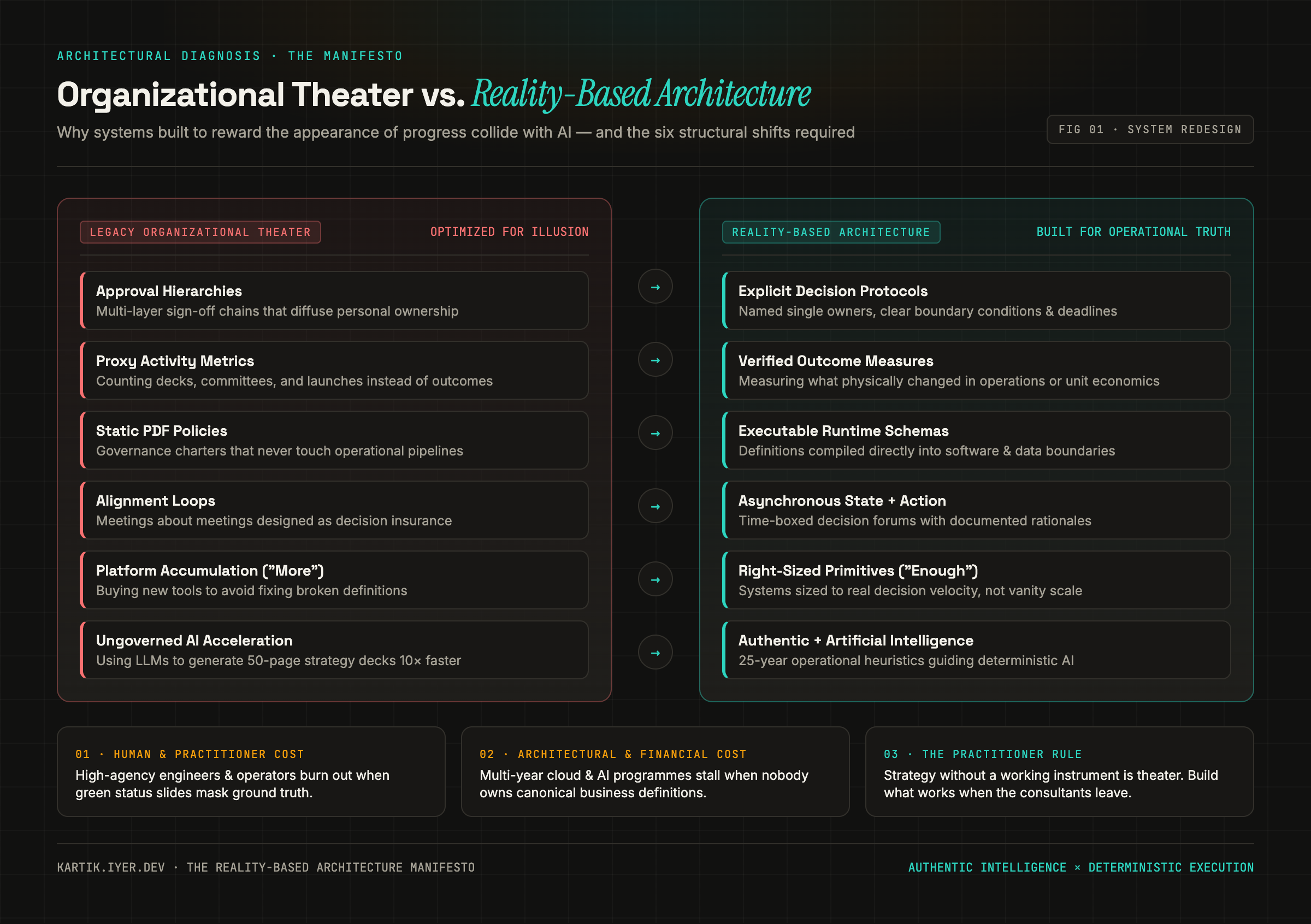
While personal candor matters, durable transformation requires redesigning the enterprise operating system itself:
| Legacy Organizational Theater | Reality-Based Architecture |
|---|---|
| Multi-layer approval hierarchies | Explicit decision protocols with named owners |
| Proxy activity & volume metrics | Verified outcome & unit-economic measures |
| Static PDF governance policies | Deterministic runtime schemas & circuit-breakers |
| Status & “alignment” meetings | Asynchronous state + time-boxed decision forums |
| Endless platform accumulation (“More”) | Right-sized, high-adoption primitives (“Enough”) |
| Cloud-leaked prompt experimentation | Zero-knowledge local AI & governed agentic vaults |
Why I Built This Platform
Everything on this site is a working artifact of this manifesto:
- Applied AI & Zero-Knowledge Engineering: Tools like SightGlass AI (offline WebGPU Gemma-4 document analysis with zero cloud egress), Chartr (turning business pain points into Monte-Carlo-simulated readiness charters in minutes), and the Responsible AI Innovation Tool (RIT).
- Public & Macroeconomic Data Intelligence: Systems like DataRadar (DIKW procurement intelligence across €2T+ of European government tenders) and interactive D3 macroeconomic analyses (The Big Churn Fallacy, The Dutch Reckoning).
- 25-Year Field Notes & Decision Instruments: Essays diagnosing Paper Tigers, Manufactured Urgency, The Big Churn, and The Myth of Corporate Alignment, paired with interactive instruments (REAL Check, ENOUGH Check, PALM Meeting Builder).
- Open International Standardization: Authoring the open-source Open Data Governance Standard (ODGS) (DOI:
10.5281/zenodo.18564270) and contributing in a personal capacity to national (NEN) and European (CEN-CENELEC JTC 25) standardization.
No membership required. No certification theater. Just the daily discipline of building systems that survive contact with reality.
The Dutch Reckoning: AI Automation and the Sovereign Fiscal Architecture of the Netherlands
One-third of Dutch government revenue (€142B/yr) flows directly from employment contributions. What happens when 3.33 million white-collar roles enter the AI automation zone?
The 3-Layer Architecture: Directives, AI Orchestration, and Deterministic Execution
LLMs are probabilistic in an enterprise world that demands determinism. How separating Directives, Orchestration, and Execution makes AI reliable.
The Big Churn: RTO Mandates, Performative Presenteeism, and the Age of Stealth Downsizing
Why blanket return-to-office mandates function as quiet layoffs, and what that costs the workforce that stays.
The Art of AI-ing Better: Human Wisdom as AI Compass
AI amplifies whatever process it's bolted onto, broken or not. How 25 years of domain pattern recognition guides AI to compress six-month cycles into hours.