The Dutch Reckoning: AI Automation and the Sovereign Fiscal Architecture of the Netherlands
One-third of Dutch government revenue (€142B/yr) flows directly from employment contributions. What happens when 3.33 million white-collar roles enter the AI automation zone?
There is a version of this story that Dutch policymakers tell themselves, and it goes roughly like this: the Netherlands is a small, open, highly educated economy with world-class digital infrastructure, the strongest English proficiency of any non-native-speaking country on earth, one of the world’s deepest pension asset pools, and a tripartite labor governance model that has navigated every major economic disruption since 1982. We will be fine.
That story is not wrong. But it is incomplete.
The Netherlands operates a sovereign fiscal architecture in which roughly one-third of government revenue flows directly from employment contributions. Not taxes on corporate profits, consumption, or property — employment contributions. Social Security Contributions (Sociale Premies) paid by workers and employers fund the state pension, unemployment insurance, health insurance, and disability benefits. In 2024, that base stood at €142 billion a year.
What happens to that €142 billion when white-collar roles begin to compress?

The Structural Point of Failure
Every major economic disruption gets filtered through an institutional model. In the Netherlands, that filter is the poldermodel — the tripartite consensus architecture bringing employers (VNO-NCW), unions (FNV, CNV), and government together to negotiate macroeconomic policy. It produced the 1982 Wassenaar Agreement, which traded wage moderation for employment protection and kick-started the Dutch economic renaissance. It navigated the 2008 financial crisis with far less political rupture than most European peers.
The poldermodel has one known failure mode: velocity. The Wassenaar Agreement took 18 months of negotiation to produce. The 2008 crisis package moved faster only because the crisis was visible, acute, and undeniable. The poldermodel excels at durable consensus, but struggles to act quickly in the absence of a visible shock.
AI automation of Dutch white-collar work is not arriving as a single headline shock. It is arriving as a gradual substitution of cognitive routine work — document processing, financial analysis, AML compliance screening, case management, code review, contract drafting — through headcount freezes and hiring compression. ABN Amro announced 5,200 planned cuts by 2028. ING cut roughly 950 domestic positions. Across Dutch banking, 2,600 AML compliance roles have been flagged for automation.
What does not yet exist is a published public model of what this does to Sociale Premies revenue over the next decade. The Centraal Planbureau (CPB) baseline projections assume structural employment stability, and no single ministry owns the cross-cutting fiscal question.
The Math That Needs to Be Run
The Netherlands has approximately 9.8 million workers in the SSC-contributing workforce, with a mean annual contribution of roughly €14,490 per worker (€142B ÷ 9.8M). Applying the ILO’s benchmark of 34% high-exposure occupations in advanced economies places 3.33 million Dutch workers inside the generative AI automation zone.
Not all of those roles will be displaced. The critical planning question is what fraction transitions out of full SSC-generating employment, and over what timeline:
- Bull Case (10% displacement by 2031): 333,000 roles — €4.8 billion per year in lost SSC revenue. Painful, but manageable through standard fiscal adjustment.
- Base Case (25% displacement by 2031): 833,000 roles — €12.1 billion per year in lost SSC revenue.
- Bear Case (35% displacement by 2031): 1.17 million roles — €16.9 billion per year in lost SSC revenue, comparable to eliminating the entire Dutch corporate income tax base.
The Sectors That Matter Most
Conventional automation debates focus on factories, warehouses, and transport. Those risks are real, but they are concentrated in sectors with lower per-worker SSC contribution indices. The fiscal exposure sits in white-collar services:
- Professional Services (Legal, Accounting, Consulting, HR): 62% task exposure and an SSC contribution index at 150% of the Dutch mean. When junior research, due diligence, and audit testing compress from days to minutes, firms do not fire partners — they hire fewer associates.
- Financial Services: 52% exposure and an SSC index at 160% of the Dutch mean. Transaction monitoring, KYC/AML compliance, and credit underwriting are among the first workflows being automated at scale across Dutch banks.
- IT & Technology Services: 48% exposure, driven by productivity compression as smaller engineering teams ship what previously required large squads.
By contrast, healthcare and education face acute structural labor shortages in the Netherlands (including a projected 266,000 healthcare worker shortfall by 2035). In those sectors, AI absorbing administrative burden acts as relief rather than net employment displacement.
The ROAM Governance Audit
Applying the enterprise ROAM risk framework (Resolved, Owned, Accepted, Mitigated) to Dutch sovereign fiscal risk highlights where institutional ownership breaks down:
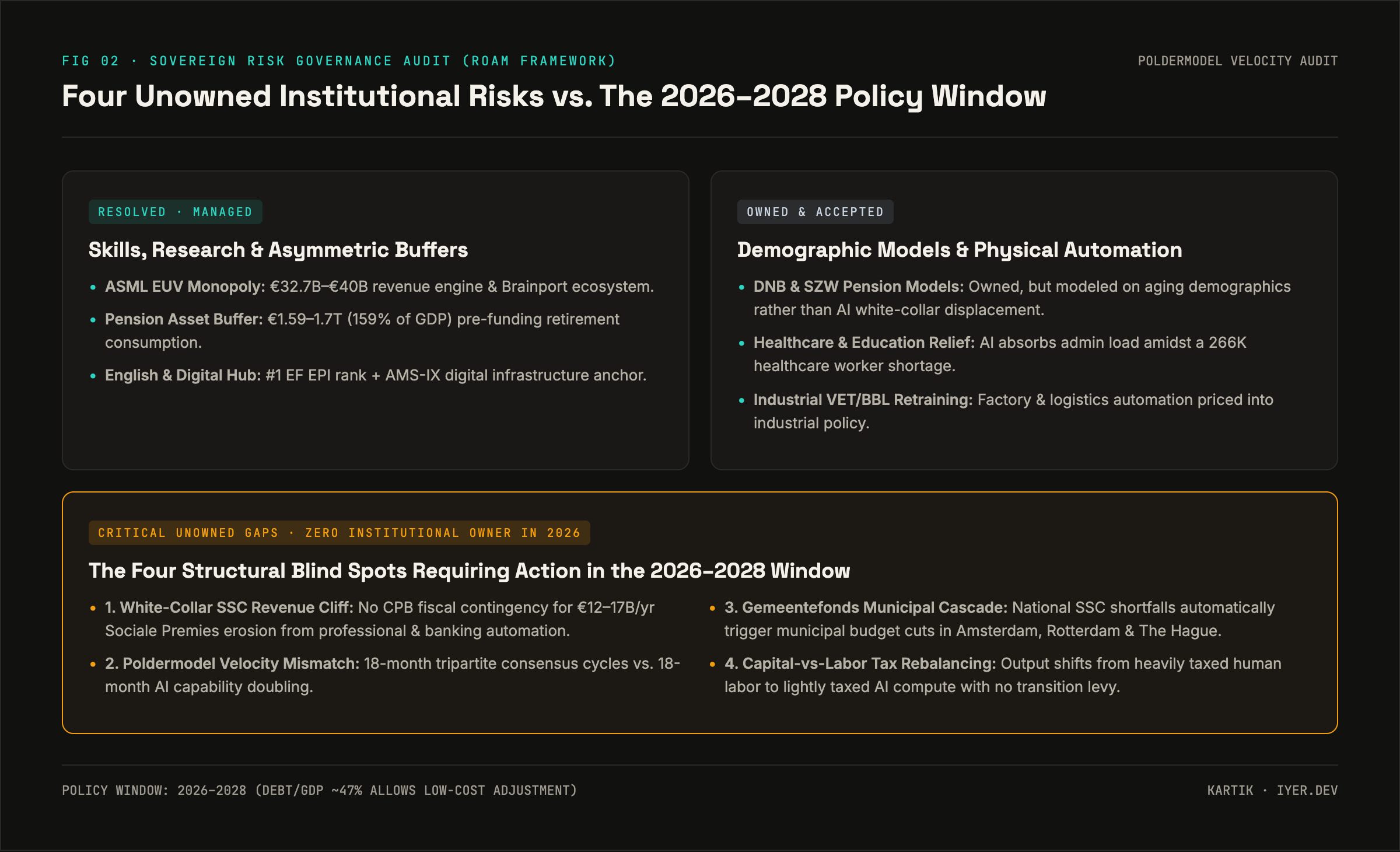
- Resolved: Research capacity (Dutch AI Delta Plan), workforce English fluency (#1 globally on EF EPI), and digital connectivity (AMS-IX) are genuine strengths.
- Owned (with incomplete models): Pension sustainability is supervised by DNB and the Ministry of Social Affairs, though modeled primarily for demographic aging rather than white-collar AI compression.
- Accepted: Physical industrial and logistics automation is already priced into VET/BBL retraining policy.
- Unowned Gaps: Four interconnected risks currently lack an institutional owner:
- The White-Collar SSC Revenue Cliff: No fiscal contingency for a €12–17B annual shortfall in Sociale Premies.
- The Poldermodel Velocity Mismatch: Consensus cycles measured in years colliding with capability cycles measured in months.
- The Gemeentefonds Municipal Cascade: Municipal transfers to cities like Amsterdam, Rotterdam, and The Hague are indexed to national fiscal receipts; an SSC erosion triggers automatic local budget pressure.
- Capital-vs-Labor Tax Rebalancing: As output shifts from heavily taxed human labor to lightly taxed compute capital, the tax architecture requires structural redesign.
The Asymmetric Bull Case — and the 2026–2028 Window
The Netherlands possesses real resilience buffers that few European peers can match:
- ASML & Brainport Eindhoven: Every leading-edge AI accelerator routes through ASML’s EUV lithography monopoly (€32.7B–€40B revenue engine), generating corporate tax and high-wage domestic employment as global AI CapEx scales.
- The €1.6 Trillion Pension Buffer: At ~159% of GDP, Dutch retirement consumption is pre-funded to a degree unmatched in continental Europe.
- Low Sovereign Debt (~47% Debt/GDP): Well below Maastricht thresholds, giving the Netherlands genuine fiscal room to act early.
That fiscal space creates a clear 2026–2028 policy window. Updating CPB fiscal models to include white-collar AI displacement scenarios, establishing an SSC Stabilization Reserve while debt is low, and scaling targeted transition mechanisms can all be done within the poldermodel — provided institutions start the clock before the fiscal math narrows their options.
The 3-Layer Architecture: Directives, AI Orchestration, and Deterministic Execution
LLMs are probabilistic in an enterprise world that demands determinism. How separating Directives, Orchestration, and Execution makes AI reliable.
The Reality-Based Architecture Manifesto: Authentic Intelligence Over Organizational Theater
Why 25 years of corporate systems optimized for the appearance of progress are now colliding with AI — and how to re-architect the building itself.
The Big Churn: RTO Mandates, Performative Presenteeism, and the Age of Stealth Downsizing
Why blanket return-to-office mandates function as quiet layoffs, and what that costs the workforce that stays.
The Art of AI-ing Better: Human Wisdom as AI Compass
AI amplifies whatever process it's bolted onto, broken or not. How 25 years of domain pattern recognition guides AI to compress six-month cycles into hours.