The Illusion of Indispensability: Breaking Free from Manufactured Urgency
Most deadline panic is manufactured, not real. A field guide to telling the difference — and shielding teams from performative churn.
After more than two decades navigating the currents of corporate life, from bustling operational floors to strategic boardrooms, I’ve seen a recurring shadow play: the Illusion of Indispensability. It’s a close cousin to the Paper Tiger, but its specialty is a different kind of performance – the art of manufacturing urgency around tasks that, upon closer inspection, are often far from critical to the organization’s core mission.

We’ve all been there. The email marked “URGENT!!!” lands at 4:55 PM on a Friday, demanding a “critical” update to a spreadsheet for a Monday morning internal review. Or the frantic scramble to polish a 50-slide deck for a meeting that might get rescheduled anyway. The implicit (and sometimes explicit) message is that the world will stop spinning if this particular document isn’t perfected right now. This isn’t about genuine, customer-facing emergencies or market-shifting deadlines. This is about the internal churn, the endless cycle of reports, presentations, and updates that fuel a perception of high stakes and vital importance.
The Anatomy of Manufactured Urgency
This phenomenon isn’t accidental; it’s a symptom of systems that often reward the appearance of frantic activity over thoughtful, paced execution. Here’s what it looks like in the wild:
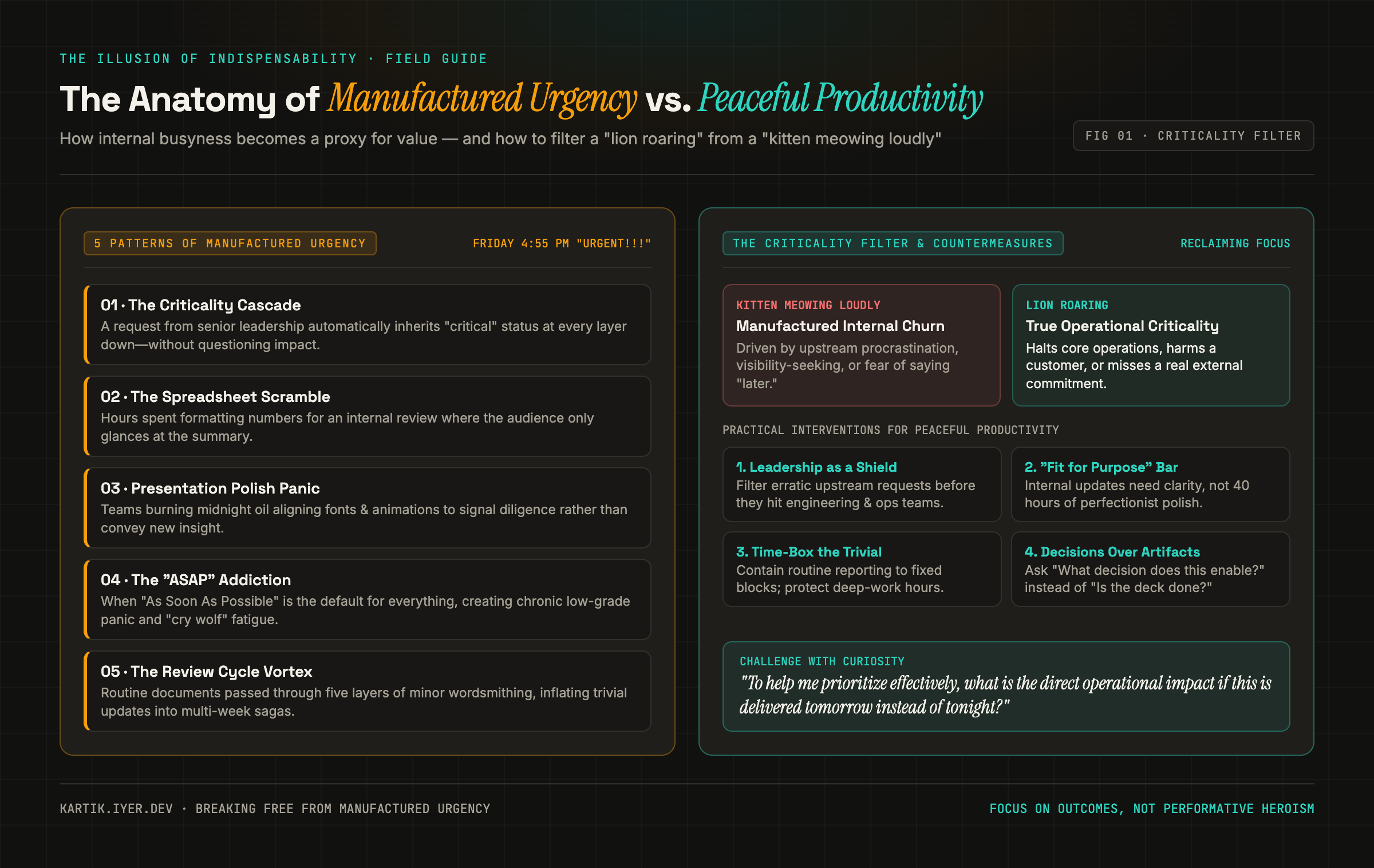
- The “Criticality Cascade”: A request from higher up the chain automatically inherits a “critical” status, regardless of its actual impact. Each layer down amplifies the perceived urgency, often without questioning the original need or timeline.
- The Spreadsheet Scramble: Hours spent formatting, re-formatting, and triple-checking numbers for an internal report whose primary audience might only glance at the executive summary. The effort invested is wildly disproportionate to the insight derived.
- The Presentation Polish Panic: Teams burning the midnight oil to ensure every animation is perfect, every font is aligned, for a presentation that is often more about signaling diligence than conveying groundbreaking information. The content becomes secondary to the performance of its creation.
- The “ASAP” Addiction: A culture where “As Soon As Possible” is the default timeframe for almost everything, leading to a constant state of low-grade panic and an inability to distinguish the truly vital from the merely requested.
- The Review Cycle Vortex: Documents passed through multiple hands for “feedback,” each round adding minor tweaks and extending timelines, creating a sense of prolonged, high-stakes effort around what might have been a simple task.
Why Do We Create This Stress? The Engines of Illusion
Understanding why this happens is key to dismantling it:
- Visibility as Value: In many corporate structures, tasks that are visible to leadership are often conflated with tasks that are valuable. The more senior the requester, the more “critical” the request, irrespective of its content.
- The Proxy for Productivity: In the absence of clear outcome metrics for knowledge work, busyness and responsiveness become proxies for performance. Being seen to react instantly, to work late on that “critical” deck, signals commitment.
- Poor Upstream Planning: Often, the “urgency” felt by a team is a direct result of procrastination or poor planning further up the food chain. The consequences are then cascaded downwards as a manufactured crisis.
- The “Importance” Echo Chamber: Individuals may inadvertently (or purposefully) inflate the importance of their own requests to feel more significant or to ensure their tasks get prioritized in a noisy system.
- Fear of Saying “No” or “Later”: A pervasive fear, especially amongst more junior employees, that questioning a deadline or pushing back will be seen as uncooperative or incapable.
The Real Cost: Beyond the Keyboard
This constant hum of manufactured urgency isn’t just inefficient; it’s corrosive:
- Human Toll: It leads directly to burnout, anxiety, and a diminished sense of purpose. When every task is “critical,” nothing feels truly meaningful. It breeds cynicism and disengagement.
- Shallow Work: The pressure for speed over substance means less time for deep thinking, creativity, and genuine problem-solving. We optimize for completion, not for excellence or innovation.
- Erosion of Trust: The “cry wolf” effect. When everything is urgent, truly critical alerts lose their impact.
- Organizational Drag: Resources (time, energy, focus) are squandered on low-impact, performative tasks instead of activities that drive real business value or customer satisfaction.
Towards Peaceful Productivity: Reclaiming Our Focus
Breaking free from this cycle requires a conscious shift, both individually and organizationally:
- Challenge with Curiosity: Instead of immediate panic, cultivate the habit of (respectfully) seeking clarity. “To help me prioritize this effectively, could you clarify the absolute latest this is needed and the direct impact if it’s delayed by a day?”
- Distinguish True Criticality: What genuinely stops the business, harms a customer, or misses a non-negotiable external commitment? Create a mental (or team-based) filter. Is this a lion roaring, or a kitten meowing loudly?
- Define “Good Enough” for Internal Outputs: Not every document needs to be a masterpiece. For internal reports or updates, agree on a standard of “fit for purpose” that doesn’t demand perfectionism.
- Time-Bound the Trivial: Allocate specific, limited time blocks for routine updates or internal paperwork. Don’t let them bleed into and dominate high-value work time.
- Leadership as a Shield: Leaders have a crucial role in filtering requests, pushing back on unreasonable timelines from above, and modeling calm, prioritized execution for their teams. They must actively debunk the “everything is critical” myth.
- Focus on Outcomes, Not Artifacts: Shift the conversation from “Is the spreadsheet done?” to “What decision does this spreadsheet enable?” or “What problem does this presentation solve?”
- Embrace Asynchronous Communication: Reduce the expectation of instant responses for non-time-sensitive matters. Encourage focused work over constant availability.
The truth is, most of the internal documents, spreadsheets, and slides are means to an end, not the end itself. Their creation should serve a clear purpose, not become a source of undue stress and performative heroism. By recognizing the “Illusion of Indispensability” and the manufactured urgency it breeds, we can start to reclaim our time, our focus, and our sanity — paving the way for a more reality-based and ultimately more productive way of working.
The Dutch Reckoning: AI Automation and the Sovereign Fiscal Architecture of the Netherlands
One-third of Dutch government revenue (€142B/yr) flows directly from employment contributions. What happens when 3.33 million white-collar roles enter the AI automation zone?
The 3-Layer Architecture: Directives, AI Orchestration, and Deterministic Execution
LLMs are probabilistic in an enterprise world that demands determinism. How separating Directives, Orchestration, and Execution makes AI reliable.
The Reality-Based Architecture Manifesto: Authentic Intelligence Over Organizational Theater
Why 25 years of corporate systems optimized for the appearance of progress are now colliding with AI — and how to re-architect the building itself.
The Big Churn: RTO Mandates, Performative Presenteeism, and the Age of Stealth Downsizing
Why blanket return-to-office mandates function as quiet layoffs, and what that costs the workforce that stays.