The Myth of Corporate Alignment
Why 'making sure everyone is aligned' is usually corporate code for indecision, diffused accountability, and risk aversion.
“We need to make sure everyone’s aligned before moving forward.”
If you’ve spent more than a month in any corporate environment, you’ve heard this phrase. It sounds reasonable — even responsible. After all, who could argue against everyone being on the same page?
But after 25 years of watching “alignment” rituals play out across global organizations of every size and sector, I’ve observed something troubling: alignment is rarely about actual coordination. Instead, it has become corporate code for indecision, risk aversion, and maintaining power structures.
The Alignment Paradox
The more an organization talks about alignment, the less decisive action it typically takes. This isn’t coincidental — it’s causal.
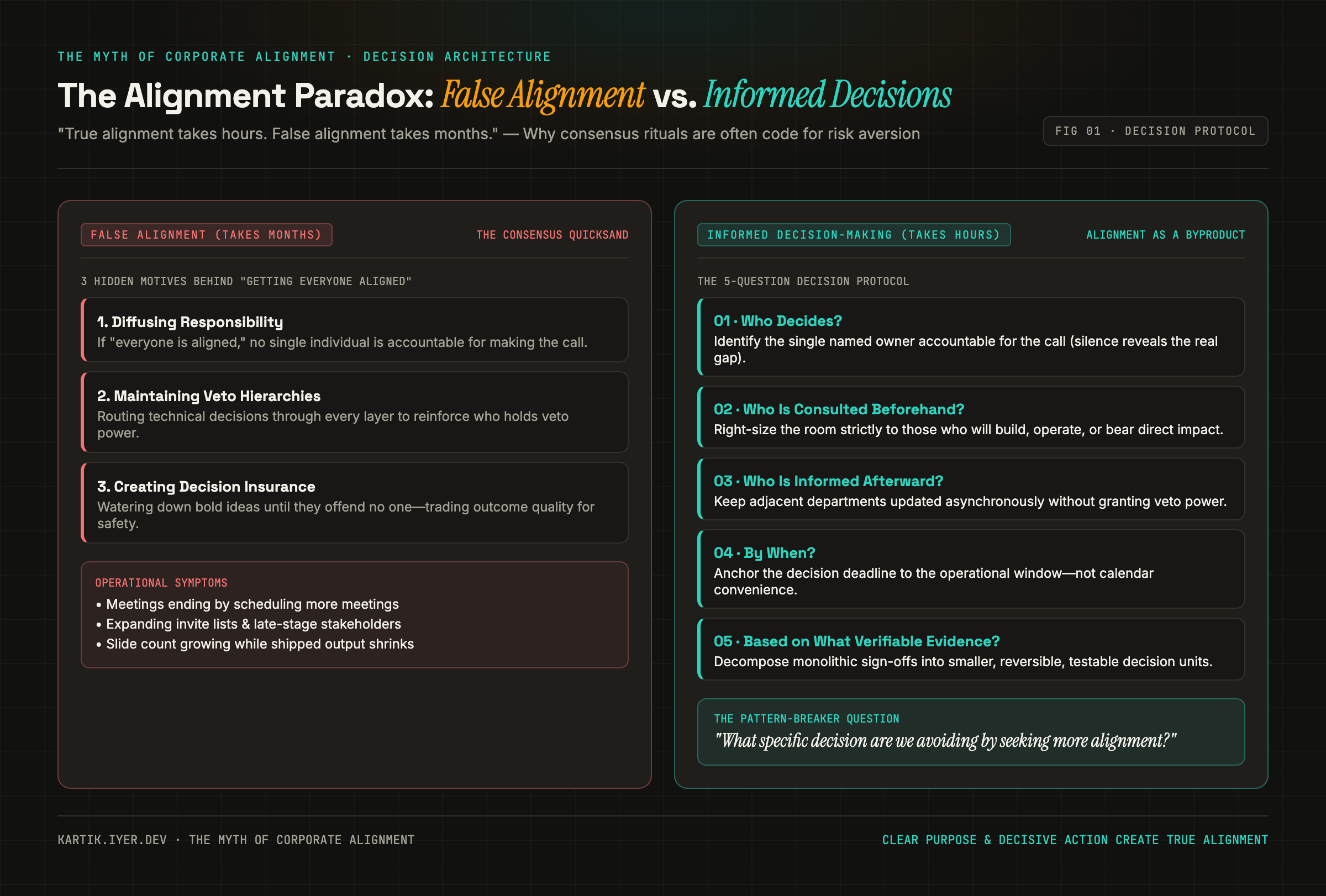
True alignment takes hours. False alignment takes months.
When a team is genuinely working toward a clear objective with defined roles and responsibilities, alignment happens organically through focused work and clear communication. It is efficient and energizing.
What most organizations call “alignment,” however, is actually an elaborate series of approval-seeking exercises designed to:
- Diffuse Responsibility: By insisting that “everyone needs to be aligned,” no single person has to take accountability for a decision.
- Maintain Power Hierarchies: Extended alignment processes ensure that decisions pass through every level of hierarchy, reinforcing who holds veto power.
- Create Decision Insurance: If something fails after “everyone was aligned,” no individual can be blamed.

The High Cost of False Alignment
This pathological approach to alignment extracts a massive organizational toll:
- Opportunity Costs: While you are aligning, reality is moving. Teams routinely spend four months “aligning” on an operational improvement or market window that vanishes while they are still scheduling steering meetings.
- Practitioner Burnout: Nothing demoralizes capable engineers, architects, and operators faster than endless alignment loops where no decisions are made.
- Strategic Limbo: Organizations get stuck between strategies — unable to commit to new architectures while still clinging to legacy processes.
- Reality Distortion: Consensus-driven alignment waters down bold, precise architectural ideas until they are palatable to the most conservative voice in the room.
How to Recognize False Alignment
False alignment displays unmistakable operational symptoms:
- Meetings that end with scheduling more meetings
- Expanding invite lists (“We should get three other departments’ perspective on this technical implementation detail”)
- The sudden appearance of new stakeholders late in the process
- Slide decks and documentation that grow while working output shrinks
- Decision criteria that keep shifting each week
Breaking the Alignment Trap
If you find yourself trapped in alignment quicksand, apply these reality-based interventions:
- Name the Pattern: Simply stating “I think we are in an alignment loop rather than a decision loop” changes the room’s posture.
- Request a Decision Deadline: Ask “When is the latest we need to decide this to meet our operational objective?”
- Identify the Real Decider: Ask “Who ultimately owns this call?” (Often the silence reveals there is no single owner — which is the actual root problem.)
- Right-Size the Room: Ask “Who will be directly responsible for building and operating this decision?” Those are the only people who truly need to be aligned.
- Create Smaller Decision Units: Break monolithic, cross-departmental sign-offs into smaller, reversible components owned by small teams.
Alignment vs. Informed Decision-Making
What organizations actually need is not universal consensus, but a clear protocol for informed decision-making:
- Who decides?
- Who needs to be consulted beforehand?
- Who needs to be informed afterward?
- By when?
- Based on what verifiable evidence?
In reality-based organizations, alignment is a byproduct of clear purpose and decisive action — not a prerequisite for them.
Next time someone says “we need to get aligned,” ask: “What specific decision are we avoiding by seeking more alignment?”
The Dutch Reckoning: AI Automation and the Sovereign Fiscal Architecture of the Netherlands
One-third of Dutch government revenue (€142B/yr) flows directly from employment contributions. What happens when 3.33 million white-collar roles enter the AI automation zone?
The 3-Layer Architecture: Directives, AI Orchestration, and Deterministic Execution
LLMs are probabilistic in an enterprise world that demands determinism. How separating Directives, Orchestration, and Execution makes AI reliable.
The Reality-Based Architecture Manifesto: Authentic Intelligence Over Organizational Theater
Why 25 years of corporate systems optimized for the appearance of progress are now colliding with AI — and how to re-architect the building itself.
The Big Churn: RTO Mandates, Performative Presenteeism, and the Age of Stealth Downsizing
Why blanket return-to-office mandates function as quiet layoffs, and what that costs the workforce that stays.